
"I believe in God, only I spell it Nature." Frank Lloyd Wright.
 Frank Lloyd Wright passed away 50 years ago today.
Wisconsin Governor Jim Doyle declared “Frank Lloyd Wright Remembrance Day in Wisconsin, in memory of Wisconsin’s most famous son.” I'm positive this proclamation will go down as Doyle's only meaningful accomplishment in an otherwise lackluster career as governor of the great state of Wisconsin.
Wright, who was declared the “greatest American architect of all time” by the American Institute of Architects, according to the proclamation, was born June 8, 1867, in Richland County and made his home and studio in Spring Green. Six properties in Wisconsin designed by Wright are listed as National Historic Landmarks, according to the proclamation.
Wright referred to himself as "the world's greatest architect" - while he was living. He was not a modest man (and that's putting it lightly). No - Wright can be called many things. Ladies man. Egotist. Manipulator. Conniver. Debaucherer. Control freak. Perfectionist (loosely). Opinionated. Firm. Genius. But "modest" would never make that list.
However those close to him - his wives (married three times + one lover), his close friends and associates and his apprentices - paint Wright in another way. Family man (depends on which child you talk to). Loving husband (depends on which wife you talk to). Generous. A great teacher. When it concerns FLW, emotions run the gamut.
Myself? I'm a fan. I finally got to visit Taliesin in Spring Green, Wisconsin last May, and I toured his Oak Brook home and office in Illinois a couple years ago. I love his Prairie-style homes, Fallingwater, Taliesin - though is block house style in California I could do with out.
 Fallingwater, Bear Run, Pennsylvania.
I've been researching two play projects on Wright. Unfortunately, they've been on the back burner while I tackle other plays, but I'll get to them...when the time's Wright (laugh - it's funny). The ideas are gestating inside my head. Wright was famous for that. His apprentices recall that the designs and architectural sketches (whatever you call them) for Fallingwater (above) were drawn on paper in just two hours in anticipation of owner Edward Kaufman's impromptu visit to Taliesin. Kaufman approved them immediately.
What I adore most about Frank Lloyd Wright is his candor and his passion for "organic architecture", a term he introduced and used in his philosophy of architecture as early as 1908. Wright explained it as “form and function are one,” using nature as the best example of this integration. Organic architecture is also an attempt to integrate the spaces into a coherent whole: a marriage between the site and the structure and a union between the context and the structure. for merging architecture and Nature into one. Look at pictures of Taliesin and you'll see how the building itself has become a part of the landscape. Fallingwater is another example.
For past blogs on Wright, check out the following posts: my visit to Taliesin, Architecture as Art and Wright's textile block home, La Minatura in California.
Read more!


 The visitor center. Wright designed this but never saw it completed. His original plan was to build a restaurant, and the center does include a cafe, along with a bookstore and gift shop. You hop on a bus here and you're taken to Taliesin, the Hillside School or wherever else depending on what tour package you purchase. My 2-hour Highlights Tour, which included portions of both Taliesin and the Hillside School, cost $57, a mere pittance for a Wright fan.
 Midway Barns (1938).
 The Romeo and Juliet
  Hillside School - Wright built this school (basically from the right side of the large building LEFT) for his two sisters who started the first co-educational school in Wisconsin. The building to the right of those double doors in the Taliesin Fellowship - architectural school (1932).
 The backside of Hillside.
 The bridge connecting Hillside to the Taliesin Fellowship architectural school.
 Hillside School. Toward the bottom of the picture is an old horse trough with a ring to tie horses to. It now serves as a flower planter.
 Hillside Theater. I hope to have a staged reading of my play,
 Outside the Hillside Theater.
 The front entrance to Taliesin.
 Front entrance up-close. The space to the right is Wright's office. Upon entering I promptly sat my ass on his desk chair. Inspiring!
 Above and below pictures. Obviously a 97-year-old building has the occasional crack or buckle. Actually, this sort of thing happened quite frequently while Wright was building and rebuilding Taliesin. His apprentices learned by doing, so if they made a mistake in construction or rebuilding, Wright let it be. Taliesin is spoken of in three phases - each following fires that destroyed portions of the home. Taliesin I (1911), Taliesin II (1914) and Taliesin III (1925).

 The red-colored trim used throughout Taliesin and Hillside was representative of the mixture of natural elements from the ground and river that the
  Cow stanchions used in the garden near Wright's bedroom. (I
 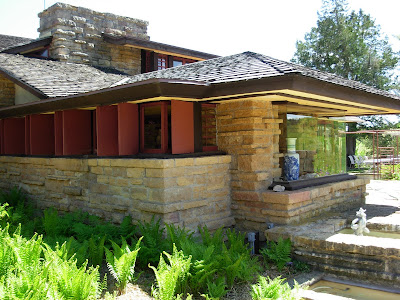 Wright's bedroom. It was being refurbished so we didn't get a look-see. The floor is sagging so they're raising it 1/8 inches per week until they return it to "level". This approach is done to

 Unity Temple, commissioned in 1886 by Wright's uncle and built by the architect
  Frank left his first wife in Chicago for
  Wright's grave at Unity Temple. Or is it? He was buried here when he died in 1959. Then his 3rd wife (Miriam Noel was his 2





 Posts
Posts


